

Memo #35: Overtime
A "time" poem a week post daylight savings

Time is one of the oldest poetic subjects, given the intersection of the practical and the sacred. We’ve measured and managed it in many different ways over millennia and across cultures. Last week, some of us “lost” an hour, and others did not. That hardly seems fair.
“We don’t experience time as moving in a constant or smooth way. Rather, we experience it slowing down, speeding up, having dips and curves, and sometimes getting stuck.
Theorists of art and poetry have long looked to the aesthetic experience as a way to address both of these problems.” - Time and the Poem by Julie Carr
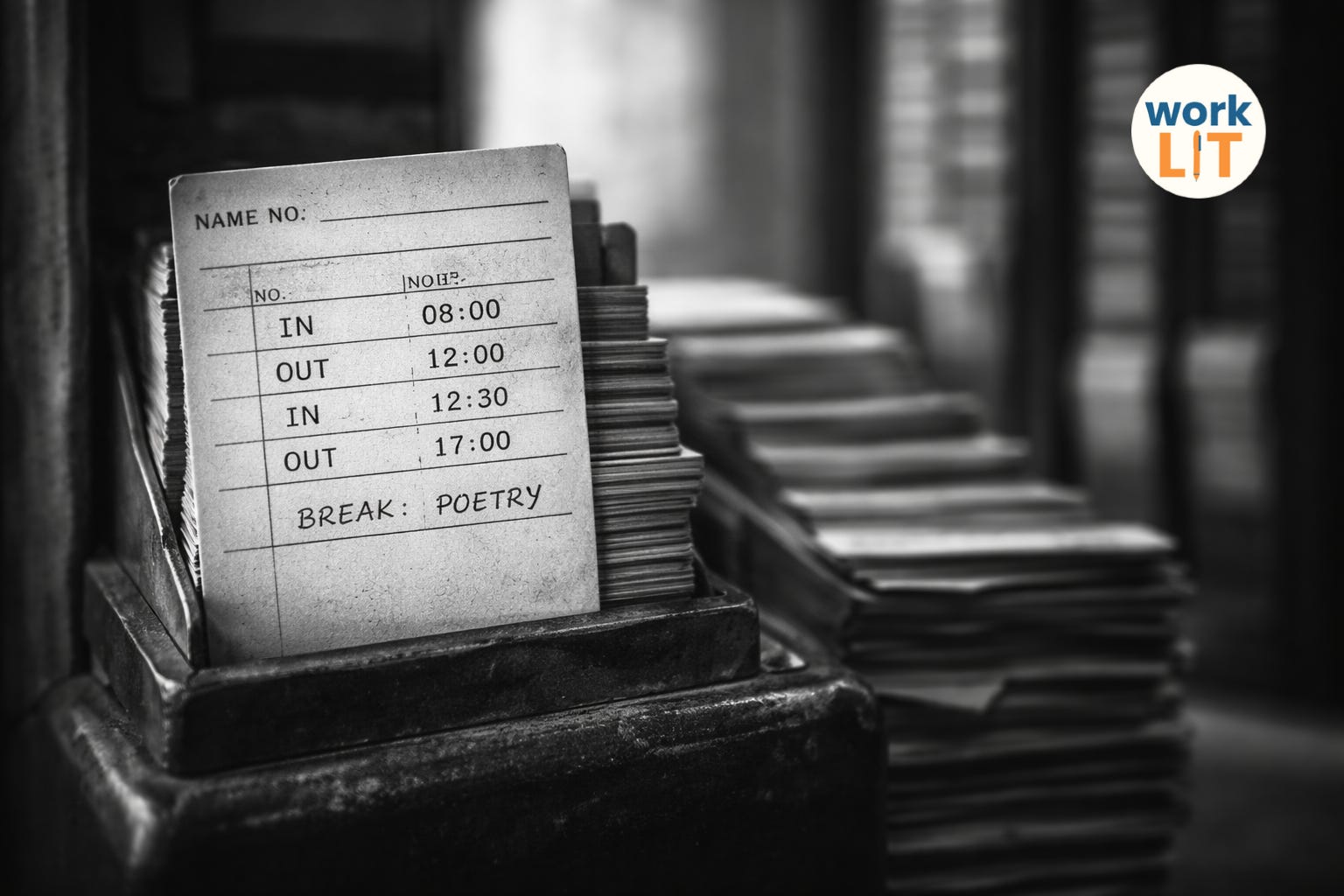
Overtime
Time passes from the left lane
in my blind spot, then speeds ahead.

Some claim to have seen it evaporate,
steam escaping from a boiling lid.

I’ve seen the danger in asking for time
to stand still, nailing it to the floor,
or tying it to a chair with ribbons
and heartstrings, impossible.

Time moves forward, straight line
from the Birth of Christ, and even before
sundials in stone.

Time is stamped, no backdating
unless I’m chasing it west,
arriving ahead of schedule.

Time is fixed, authored in the heavens.
Today, no more or less for you or me,
a communist manifesto.

But time is money, too.
It is bought and sold,
value set in hours and minutes.

So they reduce overhead
to the size of a carry-on,
with flexible shifts, day and night,
marking profitable patterns.

But overtime pays time and a half.
holidays and weekends,
working when others
are just killing time.


Heather M. Coughlin (2026)

workLIT Memo:
This past week, many moved their clocks forward an hour, while others (like me) found themselves in places where clocks stood still. Which got me thinking more broadly about time and how its measurement and value are often foundational to organizational profitability. With increasingly sophisticated workforce management tools for shift scheduling and “optimizing” human capital, the concept of overtime may soon start to feel outdated.
For now, it is interesting that the lowest-paid (e.g., shift workers) and highest-paid (e.g., consultants, law firms) are both still managed using punched clocks. Time is money.
P.S. Some of my favorite “Time” poems include “To the Virgins, to make much of Time” by Robert Herrick and Jonathan Swift’s clever short verse here:
On Time
Ever eating, never cloying,
All-devouring, all-destroying,
Never finding full repast,
Till I eat the world at last.